среда, 1 июля 2015 г.

Subscapularis – Rotator Cuff Muscle

 http://www.yoganatomy.com/subscapularis-rotator-cuff-muscle/

Subscapularis – Last of the Rotator Cuff Muscles

subscapularis rotator cuff muscleThe subscapularis is the last of the four muscles that make up the rotator cuff group and is the most powerful of the four. We have already covered the other three muscle in this group, the supraspinatus, infraspinatus, and the teres minor in previous posts.

What does Subscapularis mean?

The name of this muscle describes the location of this muscle. Sub meaning under and scapular meaning spade (which refers to the shape of the scapula) describe the location of this muscle: on the underside of the scapula.

Where does Subscapularis attach?

The muscle itself originates on the subscapular fossa of the scapula (shoulder blade).
Its insertion or humeral attachment is on the lesser (smaller) tuberosity (bump) on the front of the humerus.

What actions does Subscapularis do?

Subscapularis internally rotates the humerus.

What are the most common injuries to Subscapularis?

Subscapularis is less likely to be injured than the other rotator cuff muscles. A subscapularis tear is most likely to occur due to a traumatic event such as a fall, accident, when a rapid, strenuous movement is done without warming up, or when there weakness in the muscle after surgery.
  • Pain at the front of the shoulder
  • Feeling of weakness in the shoulder when twisting the arm inwards or lifting the arm across the front of the body
What to do?
Like tears of the other rotator cuff muscles, subscapularis tears can range from a minor strain requiring rest and possibly physical therapy exercises to a major tear requiring surgery. If you are concerned about a tear or any of the rotator cuff muscles, consult a medical professional for diagnosis and appropriate treatment.
Trigger Points
Trigger Points are fairly common amongst all of the rotator cuff muscles for yoga practitioners. Check the image below and you can read more about what trigger points are here.

Postures Where The Subscapularis Contracts

subscapularis internal reverse prayer
Hands in reverse prayer require internal rotation at the shoulder joint which is a function of this muscle.

Postures Where The Subscapularis is Lengthened

infraspinatus teres yoga anatomy
While externally rotating the arms in Eagle Pose you would lenthen the subscapuluaris

Additional Images of Subscapularis

Subscapularis - rotator cufff muscle
Trigger Points from the Subscapularis refer to the back of the arm.

The Serratus Anterior Muscle

http://www.yoganatomy.com/serratus-anterior-muscle/

 Serratus Anterior – The Boxer’s Muscle!

What does Serratus Anterior mean?serratus anterior

Serratus anterior was named for its finger like muscular origins that look serrated. “Serratus” comes from the Latin serrare meaning “to saw”.
Anterior refers to the muscles location on the front or anterior side of the body.
Serratus is known as the boxer’s muscle because it is the strongest protractor (sending it forward) of the scapula.
This anatomical movement is primarily what allows for the whole movement seen in a punch.

Where does Serratus Anterior attach?

  • Originates on the upper 8 or 9 ribs
  • Inserts on the medial border or edge of the scapula
  • There is a convergence of fibers on the inferior (bottom) angle of the scapula

What actions does Serratus Anterior do?

  • Protraction of the scapula – brings the scapula forward on the rib cage
  • Upward rotation of the scapula – Used after the humerus abducts to ninety degrees.
  • Stabilizes the scapula and prevent the inner edge from “winging”.

Postures Where The Serratus Anterior Contracts

I often find that students don’t use serratus enough. I have written about it in a number of articles already that relate to Downward Dog, Headstands, Chaturanga, and Handstands.
Having said that serratus is a key stabilizer of the scapula and is how it should be used in many yoga postures.
bakasana and serratus anterior
It contracts to keep the chest from sinking through the shoulder blades.
serratus anterior utkatasana
It upwardly rotate the scapula to get the arms over the head.

Postures Where The Serratus Anterior Lengthens

dhanurasana serratus lengthened
In dhanurasana it is lengthened as the scapula retract (get pulled back and together).

Additional Images

serratus anterior
serratus anterior muscle
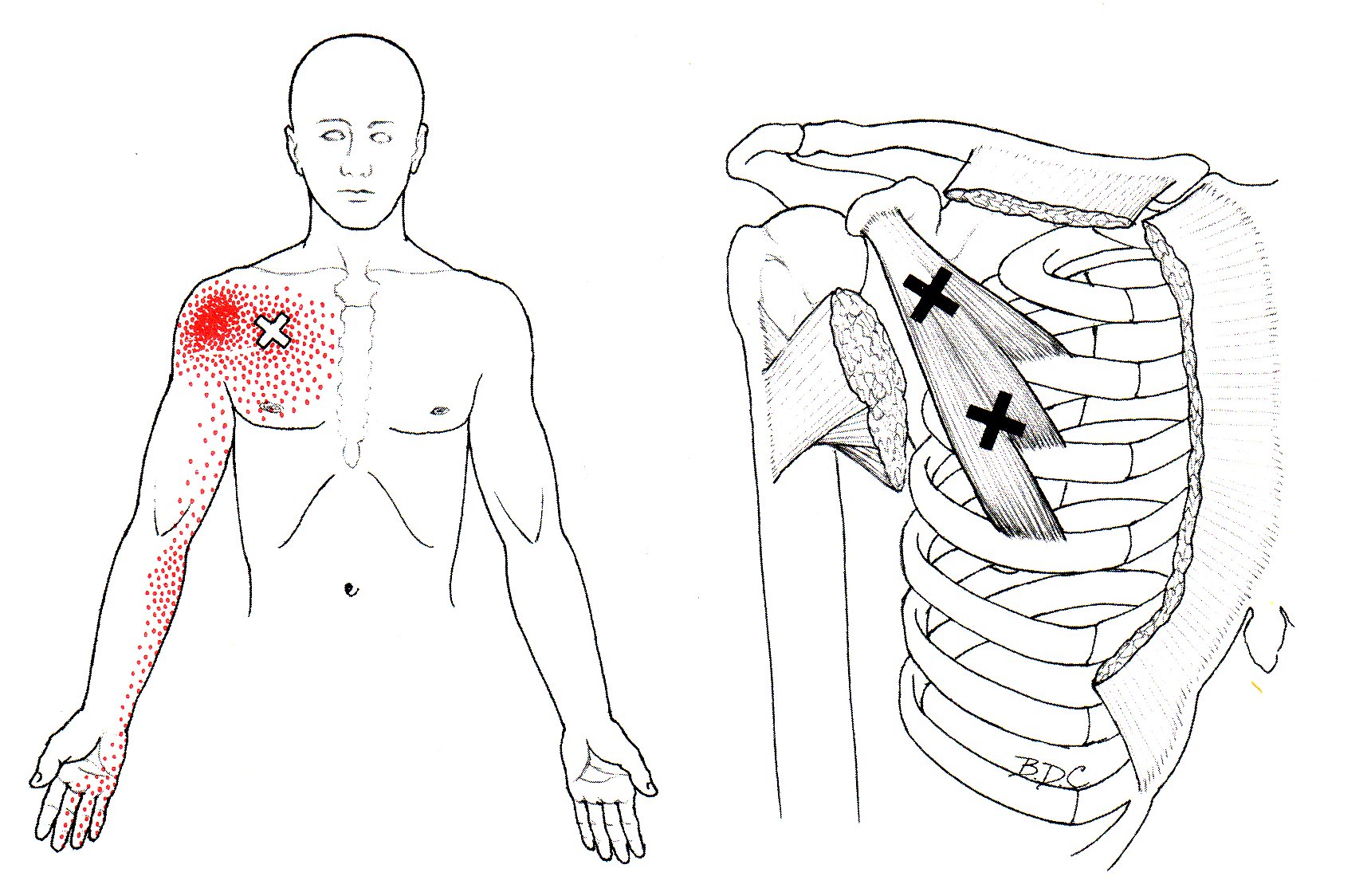
Trigger Points
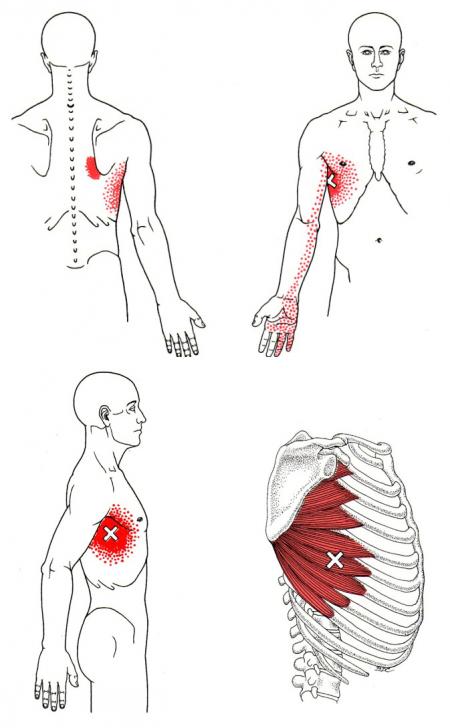
serratus anterior triggerpoints

The Latissimus Dorsi Muscle

 http://www.yoganatomy.com/latissimus-dorsi-muscle/

Latissimus Dorsi – The Swimmer’s Muscle

latissimus dorsi muscleWhat does latissimus dorsi mean?

The name of this muscle describes its size and location.
Latissimus comes from the Latin word “latus” meaning wide and dorsi comes from the Latin word “dorsum” meaning back.

Where does latissimus attach?

latissimus dorsi muscleOrigin
  • thoracolumbar aponeurosis (fancy way of saying a common tendinous sheath). It connects the attachments to the areas below with the exception of the inferior angle of the scapula.
  • T7-L5 – on the spinous processes (the parts that stick out that we can feel on our back).
  • sacrum
  • crest of the ilium (top back portion of the pelvis)
  • inferior (bottom) angle of the scapula

Insertion
  • bicipetal groove – A divot in the bone that the biceps tendon lays in.

What actions does latissimus do?

  • medial (internal) rotation of the shoulder joint
  • extension of the shoulder joint
  • adduction of the shoulder joint
  • depression of the scapula

Assists these actions
  • lateral flexion of the trunk
  • extension of the spine

Postures Where The Latissimus Dorsi Contracts

latissimus in adduction
Lattisimus contracts to bring the upper arms toward the body in adduction.

latissimus stabilizing shoudler
Latissimus helps stabilize the shoulder in Bakasana

Postures Where The Latissimus Dorsi Lengthens

latissimus lengthened
Latissimus is lengthened with the arms abducted and flexed.

Additional Images

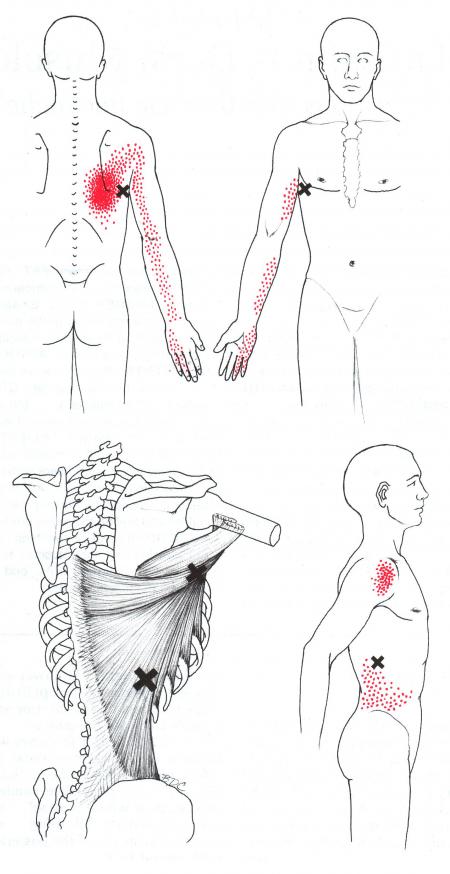
Trigger points from in the latissimus muscle.

The Rhomboid Muscle


 http://www.yoganatomy.com/rhomboid-muscle/

Rhomboids – Movers of the Scapula

What does rhomboids mean?

rhomboids yoga anatomyThe Rhomboids are named for their shape.
The name comes from the Greek “rhombos” which refers to the angled parallelogram shape.
The Rhomboids are part of the deep layer of muscles on the back. They are sometimes referred to as the Christmas tree muscles due to their shape.
The rhomboids are located between the scapula and the spine. They run deep to the trapezius.
The rhomboids are divided into a major and minor portion which originate and insert in different places.

Where does rhomboids attach?

Origin
  • Rhomboids Major – attaches on the spinous processes of vertebrae T2-T5
  • Rhomboids Minor – attaches on the spinous processes of vertebrae C7 and T1
Insertion
  • Rhomboids Major – vertebral border (edge closest to the spine) from the root of the spine to the inferior angle (bottom of the scapula)
  • Rhomboids Minor – root of the spine of the scapula

What actions does rhomboids do?

  • retraction of the scapula – scapula moves toward spine
  • downward rotation – top of the scapula tilts down and forward

Postures Where The rhomboids Contracts

rhomboid retraction shalabasana
In this variation the shoulder blades are retracting toward the spine.

Postures Where The rhomboids Lengthens

rhomboids length
With the arms in Garudasana, the shoulder blades are pulled around the front of the body lengthening the rhomboids

Additional Images

rhomboids
Trigger Points
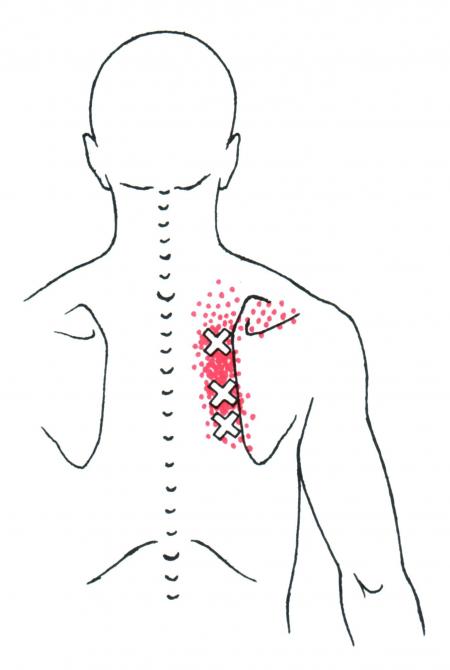
rhomboid trigger points
  

The Trapezius Muscle

http://www.yoganatomy.com/trapezius-muscle-yoga-anatomy/ 

I’m not sure that there is any muscle as deeply integrated with movement of the scapula than the trapezius.
It is divided into three sections:
  • The upper trapezius
  • The middle trapezius
  • The lower trapezius

trapezius muscle yoga anatomy
What does trapezius mean?

The name Trapezius comes from the Greek word “trapeza” which means four-sided.
Trapezius is named for its shape.
When the left and right sides are paired, they form a trapezium.
The trapezius composes the superficial layer of muscle on the back only partly covered by the large latissimus dorsi muscle.

Where does the trapezius muscle attach?

Origin of trapezius
The Upper Trapezius
– base of the occiput
– ligamentum nuchae
– spinous processes of vertebrae C1-C7
The Middle Trapezius
– spinous processes of C7 – T3
The Lower Trapezius
– spinous processes of T4 – T12
Insertion of trapezius
The Upper Trapezius
– lateral clavicle and the acromion process
The Middle Trapezius
– spine of the scapula
The Lower Trapezius
– spine of the scapula

What actions does the trapezius muscle do?

All three sections of the trapezius help in upwardly rotating the scapula. This is possible because of the points of insertion. It helps to imagine a central point around which the scapula rotates and see that the muscular attachments are like ropes on a pulley.
The Upper Trapezius also does:
Elevation
The Middle Trapezius also does:
Retraction
The Lower Trapezius also does:
Depression

What are the most common injuries to the trapezius?

The most common cause of tension in the trapezius is STRESS! Many people seem to carry their stress around in their shoulders. It’s not uncommon for the upper trapezius to be involved in headaches and torticollis (wry neck/waking up with a stiff neck). Trigger points in the trapezius can be particularly nasty and part of the headaches that are so commonly caused.

Postures Where The Trapezius Muscle Contracts

utkatasana trapezius muscle yoga anatomy

Postures Where The Trapezius Muscle Lengthens


trapezius muscle yoga anatomy
The right arm is downwardly rotating lengthening the trapezius muscle.

Additional Images

Trapezius muscle yoga anatomy
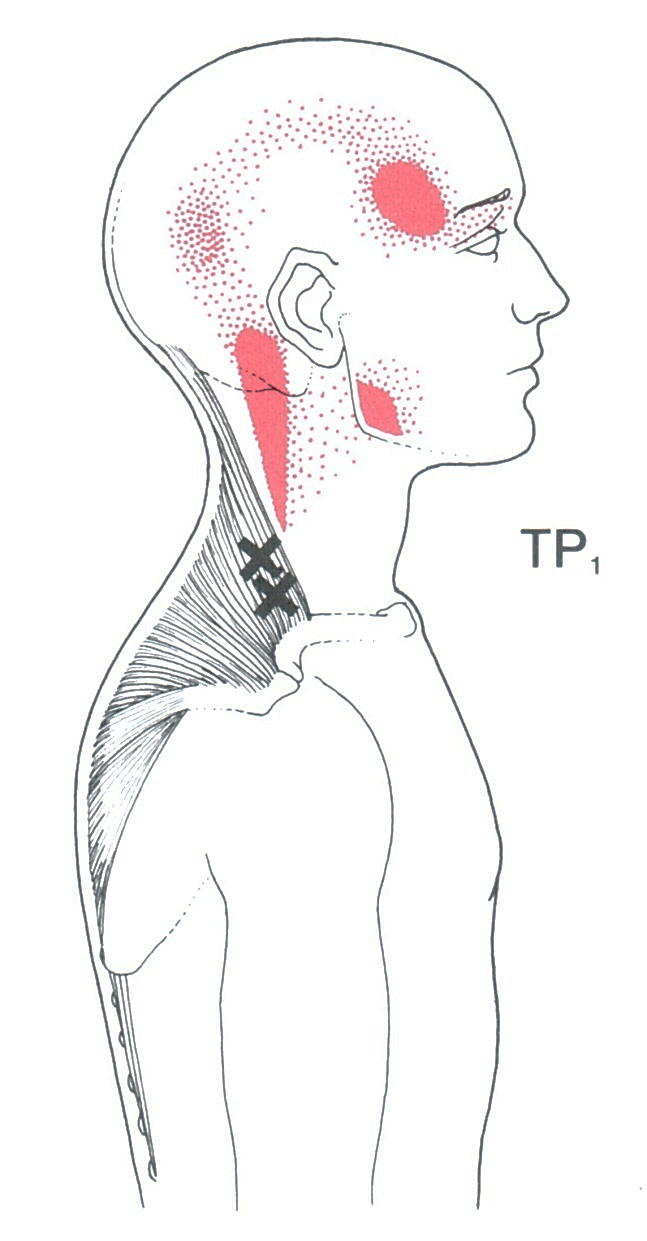
trapezius muscle trigger points
From Triggerpoints.net

The Pectoralis Minor Muscle

 http://www.yoganatomy.com/pectoralis-minor-muscle/ 

pectoralis minor muscle

The name Pectoralis minor describes the general location of this muscle.
Pectoralis comes from the Latin word “pectus” meaning breast.
Minor comes from Greek and means “the lesser”.
This is the smaller of the two Pectoralis muscles.

Where does pectoralis minor attach?

Origin
It originates on the third, fourth, and fifth rib
Insertion
The coracoid process of the scapula

What actions does pectoralis minor muscle do?

  • Depression
  • Downward Rotation
  • Protraction

What are the most common injuries to pectoralis minor muscle?

The pectoralis minor muscle doesn’t necessarily get injured. However, it is important to note that the nerves, as well as the arteries and veins that feed the arm all run beneath the pectoralis minor muscle. If the muscle is strained or gets too tight it can compress these structures causing problems all the way down the arm. At this point it usually fits in under a condition known as Thoracic Outlet Syndrome.

Postures where the pectoralis minor muscle contracts

As we push into the floor and lift our body, our scapulae depress, an action of pectoralis minor.

Postures where the pectoralis minor muscle lengthens

dhanurasana psoas muscle
In dhanurasana the scapulae are retracted, stretching the pectoralis minor. Photo Credit: Ashtangayoga.info

Additional Images

pectoralis-minor-wiki
Pectoralis Minor Trigger Points
From Triggerpoints.net

БОЛЬШАЯ КУКУРУЗИНА

Сплошная химия — говорят порой про чипсы и тому подобную еду.  


Как-то это слишком общо, подумали мы и выяснили, из чего же эта “химия” состоит. 
Перед тобой ингредиенты кукурузных чипсов “Читос с сыром”. 

Фото 1 - Большая кукурузина 

1. Кукурузная мука
2. Сульфат железа
3. Ниацин (витамин В3)
4. Рибофлавин (витамин В2)
5. Тиамин (витамин В1)
6. Фолиевая кислота (витамин В9)
7. Кукурузное или подсолнечное масло
8. Молочная сыворотка
9. Соль
10. Сыр чеддер
11. Частично гидрогенизированное соевое масло
12. Мальтодекстрин (переработанный крахмал)
13. Фосфат натрия (улучшает текстуру чипсов)
14. Сметана
15. Глютамат натрия (улучшитель вкуса)
16. Молочная кислота (консервант)
17. Искусственные красители
18. Лимонная кислота (консервант, регулятор кислотности)
 
= “Читос”! 

ФОТО: DAVIES AND STARR 

Читать всё: http://www.mhealth.ru/diet/ration/756467/#ixzz3edtg2VNa