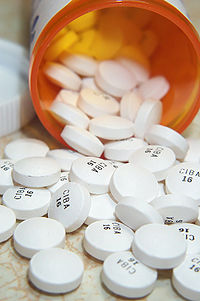
Ritalin slow-release (SR) 20 mg tablets
Stimulants (also referred to as
psychostimulants) are
psychoactive drugs which induce temporary improvements in either mental or physical functions or both. Examples of these kinds of effects may include enhanced alertness, wakefulness, and locomotion, among others. Due to their effects typically having an "up" quality to them, stimulants are also occasionally referred to as "
uppers".
Depressants or "downers", which decrease mental and/or physical function, are in stark contrast to stimulants and are considered to be their functional opposites. Stimulants are widely used throughout the world as
prescription medicines and as
illicit substances of
recreational use or
abuse.
Effects[edit]
Stimulants produce a variety of different kinds of effects by enhancing the activity of the
central and
peripheral nervous systems. Common effects, which vary depending on the substance in question, may include enhanced
alertness,
awareness,
wakefulness,
endurance,
productivity, and
motivation, increased
arousal,
locomotion,
heart rate, and
blood pressure, and the perception of a diminished requirement for
food and
sleep. Many stimulants are also capable of improving mood and relieving anxiety, and some can even induce feelings of
euphoria. However, many of these drugs are also capable of causing anxiety and heart failure, even the ones that may paradoxically reduce it to a degree at the same time. Stimulants exert their effects through a number of different pharmacological mechanisms, the most prominent of which include facilitation of
norepinephrine (noradrenaline) and/or
dopamine activity (e.g., via
monoamine transporter inhibition or reversal
[1]),
adenosine receptor antagonism, and
nicotinic acetylcholine receptor agonism.
Medical uses[edit]
Stimulants are used both individually and clinically for therapeutic purposes in the treatment of a number of indications, including the following:
- To counteract lethargy and fatigue throughout the day while at work or while doing other activities.
- To reduce sleepiness and to keep the person awake when necessary, as well as to treat narcolepsy.
- To decrease appetite and promote weight loss, as well as to treat obesity.
- To improve concentration and focus while at work or school, especially for those with attentional disorders such as ADHD.
- Occasionally, they are also used off label to treat clinical depression, more particularly, non-typical depression and treatment-resistant depression.
Ampakines[edit]
Recently, there have been improvements in the area of stimulant pharmacology, producing a class of chemicals known as
ampakines, or
eugeroics, (
good arousal). These stimulants tend to increase alertness without the peripheral (body) effects or addiction/tolerance/abuse potential of the traditional stimulants. They have minimal effect on sleep structure, and do not cause rebound hypersomnolence or "come down" effects. Ampakines such as
ampalex and
CX717 have been developed but are still in clinical trials and have not yet been sold commercially. Another compound with similar effects to these drugs is
carphedon, which is sold as a general stimulant in Russia under the brand name Phenotropil.
Amphetamines and related substances[edit]
Main article:
Amphetamine
Amphetamines are a group of
phenylethylamine stimulants such as amphetamine and methamphetamine. Like
NDRIs, amphetamine increases the levels of norepinephrine and dopamine in the brain via reuptake inhibition; however, the more important mechanism by which amphetamines cause stimulation is through the direct release of these
catecholamines from storage
vesicles in cells. Amphetamines are known to cause elevated mood and
euphoria as well as rebound
depression and
anxiety.
[2]
Amphetamines are often used for their therapeutic effects; physicians occasionally prescribe
amphetamines to treat
major depression, where subjects do not respond well to traditional
SSRI medications, and numerous studies have demonstrated the effectiveness of drugs such as
Adderall in controlling symptoms associated with
ADD/
ADHD. Due to their availability and fast-acting effects,
amphetamines are prime candidates for abuse.
[3]
Catha edulis (Khat)[edit]
Khat contains a
monoamine alkaloid called
cathinone, an
amphetamine-like
stimulant, which is said to cause excitement,
loss of appetite and
euphoria. In 1980, the
World Health Organization (WHO) classified it as a
drug of abuse that can produce mild to moderate
psychological dependence (less than tobacco or alcohol),
[6] although the WHO does not consider khat to be seriously addictive.
[5] It is a
controlled substance in some countries, such as the United States,
Canada and Germany, while its production, sale and consumption are legal in other nations, including
Djibouti,
Ethiopia,
Somalia and
Yemen.
[7]
Cathine[edit]
Cathinone[edit]
Bupropion[edit]
Bupropion (
// bew-proh-pee-on[8]) is a drug marketed as
Wellbutrin,
Budeprion,
Prexaton,
Elontril,
Aplenzin, or other trade names. It is one of the most frequently prescribed
antidepressants in the United States. Marketed in lower-dose formulations as
Zyban,
Voxra, or other names, it is also widely used as a
smoking cessation aid. It is taken in the form of pills, and in the United States is available only by prescription.
Medically, bupropion serves as a non-tricyclic antidepressant fundamentally different from most commonly prescribed antidepressants such as
selective serotonin reuptake inhibitors (SSRIs). It is an effective antidepressant on its own, but is also popular as an add-on medication in cases of incomplete response to first-line SSRI antidepressants. In contrast to many other antidepressants, it does not cause weight gain or sexual dysfunction. The most important side effect is an increase in
risk for epileptic seizures, which lead to the recommended dosage to be reduced. 300mg a day (for average body weight) has been shown to maintain the same 0.1% unprovoked seizure rate of the general population.
Dextroamphetamine ("Dexedrine", contained in "Adderall")[edit]
Dextromethamphetamine ("Desoxyephedrine", contained in "Desoxyn")[edit]
Ephedrine[edit]
L-Norpseudoephedrine[edit]
Levoamphetamine (contained in "Adderall")[edit]
Levomethamphetamine (contained in Vicks Vapor Inhaler)[edit]
Lisdexamfetamine ("Vyvanse")[edit]

Illicit tablets containing MDMA
Methylenedioxymethamphetamine (MDMA), known by its common street name "Ecstasy", typically comes in either tablet, capsule, or powder/crystal form. It had a medical application as a treatment for depression and a psychotherapy aid until 1985 when the DEA listed MDMA as a
Schedule I controlled substance, prohibiting most medical studies and applications. Notably, MDMA is also unique and very popular for its
entactogenic properties. The stimulant effects of MDMA include
hypertension,
anorexia (appetite loss),
euphoria, social disinhibition,
insomnia (or enhanced wakefulness), improved energy, increased arousal, and increased
perspiration, among others.
Mephedrone[edit]
Methamphetamines[edit]
Norephedrine[edit]
Main article:
Norephedrine
Norpseudoephedrine[edit]
Pemoline[edit]
Pentorex[edit]
Phentermine[edit]
Main article:
Phentermine
Pseudoephedrine[edit]
Dopamine precursors[edit]
Unlike amphetamines, and other substances which are dopamine agonists, which either stimulate the release or inhibit the reuptake of dopamine or norepinephrine (which itself is synthesized from dopamine, typically with the help of the amino acid SAM-e, also available as a supplement), dopamine precursors are used by the body in the manufacturing of dopamine.
L-Dopa can cross the blood-brain barrier, and can be converted by the body into dopamine.
L-Tyrosine[edit]
L-Tyrosine is the precursor that is 'closest' to being dopamine among those supplements legally available without prescription in most jurisdictions. It cannot cross the blood-brain barrier, but is converted by the body into L-Dopa, which can. Tyrosine must be taken on an empty stomach and the dosages recommended by most supplement companies may not be sufficient for a noticeable effect.
Phenylalanine[edit]
Main article:
Phenylalanine
Phenylalanine is 'one step back' from L-Tyrosine--it must be converted into Tyrosine before the Tyrosine can be converted into L-Dopa, which in turn becomes dopamine.
Eugeroics[edit]
Adrafinil[edit]
Adrafinil is the prodrug of Modafinil, and is metabolized into it in about one hour, when taken on an empty stomach.
Armodafinil[edit]
Main article:
Armodafinil
Armodafinil is an enantiopure (non-racemic) version of Modafinil with similar psychoactive properties.
CRL-40,941[edit]
JZ-IV-10[edit]
JZ-IV-10 is also an SNDRI.
Modafinil[edit]
Modafinil (Provigil/Alertec/Modavigil) is an analeptic drug approved by the (FDA) for the treatment of narcolepsy, shift work sleep disorder, and excessive daytime sleepiness associated with obstructive sleep apnea.
Modafinil, like other stimulants, increases the release of monoamines but also elevates hypothalamic histamine levels, leading some researchers to consider Modafinil a "wakefulness promoting agent" rather than a classic amphetamine-like stimulant.
Modafinil has been shown to be effective in the treatment of Attention-Deficit Hyperactivity Disorder (ADHD), depression, cocaine addiction, Parkinson's Disease, schizophrenia, shift workers' sleep disorder and disease-related fatigue.
Fencamfamine[edit]
Main article:
Fencamfamine
H3 antagonists[edit]
Main article:
H3_antagonist
Methylhexanamine (DMAA)[edit]
Fenozolone[edit]
Nicotine[edit]
NRIs, NDRIs, and SNDRIs[edit]
These drugs inhibit the reuptake of norepinephrine and/or dopamine, resulting in increased extracellular levels and therefore enhanced neurotransmission, ultimately producing a stimulant effect. Many of these compounds are used as
ADHD medications and
antidepressants. The two best-known NRIs are
atomoxetine (Strattera) and
reboxetine (Edronax). Many of these drugs have a considerably lower abuse potential in comparison to other stimulants like the amphetamines and cocaine. Reboxetine has been withdrawn from the market in the USA due to unproven efficacy and an unacceptable occurrence of dangerous side effects.
Atomoxetine[edit]
Main article:
Atomoxetine
Cocaine[edit]
Cocaine is an SNDRI. Cocaine is made from the leaves of the
coca shrub, which grows in the mountain regions of South American countries such as
Bolivia,
Colombia, and
Peru. In Europe, North America, and in some parts of Asia, the most common form of cocaine is a white crystalline powder. Cocaine is a stimulant but is not normally prescribed therapeutically for its stimulant properties, although it sees clinical use as a local anesthetic, particularly in
ophthalmology. Most cocaine use is recreational and its abuse potential is high, and so its sale and possession are strictly controlled in most jurisdictions. Other
tropane derivative drugs related to cocaine are also known such as
troparil and
lometopane but have not been widely sold or used recreationally.
[11]
Dexmethylphenidate[edit]
Fenetylline[edit]
Fenetylline is a prodrug of both Theophyline and Amphetamine.
Methylenedioxypyrovalerone[edit]
Methylphenidate[edit]
Nocaine[edit]
Norcocaine[edit]
Xanthines[edit]
Caffeine[edit]
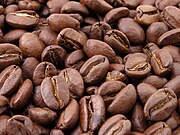
Roasted coffee beans, a common source of caffeine.
Caffeine is a stimulant compound that is found naturally in
coffee,
tea, and to a lesser degree, in
cocoa or
chocolate. It is included in many
soft drinks, as well as a larger amount in
energy drinks. Caffeine is the world's most widely used psychoactive drug and by far the most common stimulant. The vast majority (over 85%) of people in the United States consume caffeine on a daily basis.
[citation needed]A few jurisdictions restrict its sale and use. Caffeine is also included in some medications, usually for the purpose of enhancing the effect of the primary ingredient, or reducing one of its side effects (especially drowsiness). Tablets containing standardized doses of caffeine are also widely available.
Theobromine[edit]
Main article:
Theobromine
Theophylline[edit]
Main article:
Theophylline
Yohimbine[edit]
Yohimbine is a psychoactive drug of the
tryptamine chemical class with stimulant and aphrodisiac effects. Yohimbine is sometimes used to remedy
Type-2 Diabetes in animals and humans that carry the polymorphisms of the α2A-adrenergic receptor gene.
[15]
Testing[edit]
The presence of stimulants in the body may be tested by a variety of procedures. Serum and urine are the common sources of testing material although saliva is sometimes used. Commonly used tests include chromatography, immunologic assay and mass spectrometry.
[17] Patients taking ADHD-prescribed, Adderall-type amphetamine compounds are commonly surprised upon being tested as "positive" for "meth", or
methamphetamine (
Desoxyn its licit, FDA-licensed, medicinal form) in forensically unsophisticated urinalysis, as methamphetamine is the active ingredient of the drug Desoxyn, and is chemically similar to the active ingredients of other ADHD medications.
See also[edit]
References[edit]
- Jump up^ Riddle EL, Fleckenstein AE, Hanson GR (2005). "Role of monoamine transporters in mediating psychostimulant effects". The AAPS journal 7 (4): E847–51.doi:10.1208/aapsj070481. PMC 2750953. PMID 16594636.
- Jump up^ P Knapp (1952). "Amphetamine and addiction". Journal of Nervous and Mental Disorders 115: 406–409.
- Jump up^ Efforts of the National Institute on Drug Abuse to Prevent and Treat Prescription Drug Abuse, Testimony Before the Subcommittee on Criminal Justice, Drug Policy, and Human Resources Committee on Government Reform, United States House of Representatives, July 26, 2006
- Jump up^ Dickens, Charles (1856). "The Orsons of East Africa". Household Words: A Weekly Journal 14: 176. Retrieved 6 July 2013.
- ^ Jump up to:a b Khat chewing in Yemen: turning over a new leaf: Khat chewing is on the rise in Yemen, raising concerns about the health and social consequences
- Jump up^ Nutt D, King LA, Blakemore C (March 2007). "Development of a rational scale to assess the harm of drugs of potential misuse". Lancet 369 (9566): 1047–53.doi:10.1016/S0140-6736(07)60464-4. PMID 17382831.
- Jump up^ Haight-Ashbury Free Medical Clinic, Journal of psychoactive drugs, Volume 41, (Haight-Ashbury Publications: 2009), p.3.
- Jump up^ entry "Bupropion (By mouth)" at "PubMed Health" (from the US government agency NIH, National Institutes of Health), retrieved March 31, 2013.
- Jump up^ The INN originally assigned in 1974 by the World Health Organization was "amfebutamone". In 2000, the INN was reassigned as bupropion. See World Health Organization (2000). "International Nonproprietary Names for Pharmaceutical Substances (INN). Proposed INN: List 83" (PDF). WHO Drug Information 14 (2). Archived from the original on May 31, 2011. Retrieved June 22, 2009.
- Jump up^ Merck Manuals > EPHEDrine Last full review/revision January 2010
- Jump up^ AJ Giannini, WC Price (1986). "Contemporary drugs of abuse". American Family Physician 33: 207–213.
- Jump up^ "Ritalin & Cocaine: The Connection and the Controversy"
- Jump up^ "Psychiatric nursing: contemporary practice"
- Jump up^ "Why isn't methylphenidate more addictive?"[dead link]
- Jump up^ Rosengren, A. H.; Jokubka, R.; Tojjar, D.; Granhall, C.; Hansson, O.; Li, D.-Q.; Nagaraj, V.; Reinbothe, T. M. et al. (2009). "Overexpression of Alpha2A-Adrenergic Receptors Contributes to Type 2 Diabetes". Science 327 (5962): 217–20.doi:10.1126/science.1176827. PMID 19965390.
- Jump up^ Dackis CA, Gold MS (1990). "Addictiveness of central stimulants". Adv Alcohol Subst Abuse 9 (1–2): 9–26. doi:10.1300/J251v09n01_02. PMID 1974121.
- Jump up^ AJ Giannini. Drug Abuse. Los Angeles, Health Information Press, 1999, pp.203-208
External links[edit]

 Самыми известными адаптогенами являются :

 добавлением питьевой соды, 3 раза в день.
 добавлением питьевой соды, 3 раза в день.
 Лимонник – также известный как восточно-азиатская лиана. Он также энергизирует со средней силой весь организм, но больше всего нервную систему, повышает работоспособность мозга, проясняет мысли.


